 ultimate-guide
Benefits of Physician Administered Dermal Fillers
Table of Contents
- What Makes Physician Administered Dermal Fillers Different
- Dermal Filler Safety and Complications: What Physician Oversight Changes
- How to Choose a Qualified Injector for Fillers
- Dermal Filler Recovery and Aftercare for Best Results
- The Benefits of Physician Administered Dermal Fillers Beyond Appearance
- Frequently Asked Questions
Last Updated: September 23, 2026
What Makes Physician Administered Dermal Fillers Different
The core difference is who holds the needle. Physician administered dermal fillers are injectable treatments placed by a licensed doctor who has completed medical training in facial anatomy, vascular mapping, and complication management, rather than by a technician working under loose supervision. That distinction sounds administrative. It isn't.
Dermal fillers are gel-like substances, most often made from hyaluronic acid, that restore facial volume lost to aging, soften nasolabial folds, and improve facial symmetry. They sit in the dermal layers and deeper subcutaneous planes, which is exactly where nerves and blood vessels run. Knowing those planes is a medical skill, not a cosmetic one.
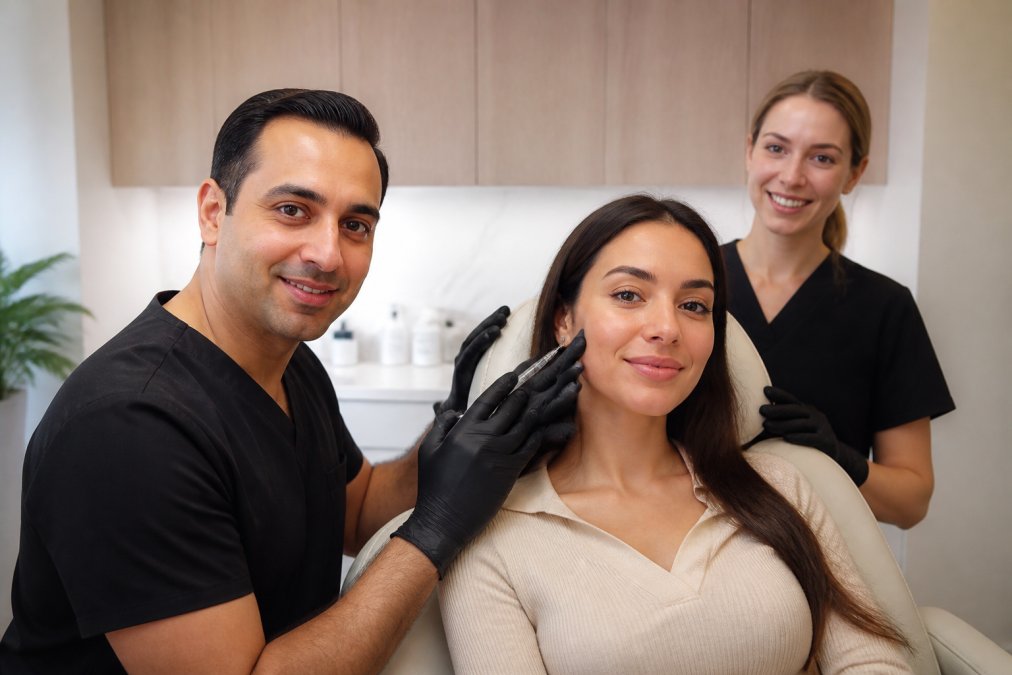
At Medical Aesthetics and Lasers, Dr. Ayaz Khan, MD evaluates each patient before any injectable is opened. Suitability is determined after medical evaluation, never before.

Dermal Filler Safety and Complications: What Physician Oversight Changes
Dermal filler safety depends less on the product than on the injector's ability to recognize and respond to problems in real time. Most adverse reactions are mild and temporary. A small number are time-critical.
Common Side Effects vs. Serious Risks
The ordinary reactions are bruising, swelling, redness, tenderness, and mild lumpiness at the injection site. These typically settle within days and are managed with cold compresses and patience.
Serious risks are rarer but real. Vascular occlusion, where filler blocks a blood vessel, can compromise skin and, in rare cases, vision. Infection and granuloma formation are also possible.
Emergency Reversal: Hyaluronidase and Vascular Occlusion Protocols
Hyaluronic acid fillers are reversible. Hyaluronidase, an enzyme that breaks down hyaluronic acid, can dissolve misplaced filler, and physicians keep it on hand for exactly that reason. This reversibility is one of the strongest arguments for HA-based products over permanent or synthetic fillers.
How to Choose a Qualified Injector for Fillers
Choosing a qualified injector for fillers comes down to four things: credentials, consultation quality, emergency preparedness, and honesty about limits. Verify each before you book.
Credentials, Consultation, and Red Flags to Avoid
Start with licensure and training. A board-certified physician or a licensed provider working under direct physician supervision is the baseline, not a bonus. Ask who will actually hold the needle, and ask what happens if something goes wrong.
A practical pre-treatment checklist:
- Confirm the injector's license and supervising physician
- Ask which fillers are used and whether they are hyaluronic acid based
- Confirm hyaluronidase is available on site
- Ask for a full consultation before any injection
- Get a written plan with product names and areas treated
- Walk away if you are pressured to decide the same day
Dermal Filler Recovery and Aftercare for Best Results
Dermal filler recovery is short, but the first two weeks determine how the result settles. Most patients return to work the same day. What changes the outcome is what happens to the tissue underneath, and how quickly you recognize when normal swelling stops being normal.
What Happens in the Tissue After Injection
Hyaluronic acid fillers are hydrophilic, meaning they attract and bind water. That property is why the treated area often looks fuller on day two than it did immediately after injection, the product is still integrating with surrounding tissue and drawing in fluid. Swelling typically peaks within 24 to 48 hours and then resolves over the following week.
A Realistic Recovery Timeline
| Timeframe | What to Expect | What to Do |
|---|---|---|
| First 24 hours | Swelling, redness, tenderness, possible pinpoint bruising | Cold compress in short intervals, keep head elevated, no exercise or alcohol |
| Days 2-7 | Bruising fades through yellow-green stages, minor lumps soften | Avoid facial massage, saunas, direct heat, and blood-thinning medications unless cleared |
| Weeks 2-4 | Final result visible, product integrated | Attend the two-week follow-up, take comparison photos |
| Beyond 4 weeks | Stable result, maintenance clock begins | Plan the next interval with your physician, not on impulse |
Skip strenuous exercise, alcohol, and blood-thinning medications for the first day or two unless a physician says otherwise. Avoid facial massage, saunas, and direct heat. Sleep slightly elevated if you are prone to swelling. Cold compresses help, but keep pressure light, firm pressure on freshly injected filler can displace it.
When Recovery Is Not Normal: Triage Signals
Most swelling and bruising is expected. A small set of symptoms is not, and the difference is time-critical.
- Severe or escalating pain disproportionate to the procedure
- Blanching (white patches) or dusky, gray-blue discoloration of the skin
- Vision changes, including blurred vision or blind spots
- Spreading discoloration beyond the treated area
- Fever or signs of infection at the injection site
Aftercare Choices That Protect Your Investment
- Hydration supports the hydrophilic nature of HA fillers, dehydrated skin shows filler less well
- Daily broad-spectrum sunscreen slows the collagen breakdown that makes volume loss recur
- Consistent sleep position (back or side, not face-down) reduces morning asymmetry in the first week
- Avoid dental work, facials, and other facial procedures for at least two weeks unless cleared
At Medical Aesthetics and Lasers, every filler patient receives written aftercare instructions. Physician-led recovery means someone who can run an emergency protocol is reachable, not just a front desk.
The Benefits of Physician Administered Dermal Fillers Beyond Appearance
The benefits of physician administered dermal fillers extend past wrinkle reduction. Aesthetic enhancement is the visible outcome. The quieter advantages, reversibility, cumulative tissue effects, psychological impact, and cost behavior over years, are where physician oversight actually changes the value equation.
Reversibility: The Benefit Most Guides Skip
Hyaluronic acid fillers are the only major filler category that can be dissolved on demand. Hyaluronidase, an enzyme that cleaves the HA molecule, can break down misplaced or unwanted filler within hours to days depending on the volume and product used.
- Overcorrection or asymmetry, a result that is too full or uneven can be partially or fully reversed rather than waited out.
- Vascular occlusion, if filler enters a blood vessel, hyaluronidase is the primary emergency intervention. Physicians keep it stocked and know the dosing protocol.
- Change of mind, a patient who decides the look is not right is not locked in.
Long-Term Maintenance and Cumulative Effects
Fillers are not a one-time purchase, and the way they accumulate in tissue is more nuanced than "top up every six months."
- Lip filler: 6 to 12 months
- Cheek and midface filler: 9 to 18 months
- Nasolabial fold filler: 6 to 12 months
- Biostimulators (Sculptra, Radiesse): results build over 2 to 3 months and can last 1 to 2 years or more
Psychological Benefits Beyond the Mirror
Facial rejuvenation affects how people feel in rooms, not just in mirrors. Patients frequently describe improved confidence in professional and social settings, and that effect is a legitimate outcome, not a vanity metric. The psychological benefit is often most pronounced in patients who felt their appearance no longer matched how they felt internally, a mismatch that shows up in photos, video calls, and first impressions.
Cost-Benefit Over Time, Not Per Visit
A single surgical procedure carries a larger upfront figure and longer downtime. Injectable treatments spread cost across visits, involve minimal downtime, and remain adjustable. Because HA fillers can be dissolved, an unsatisfactory result is not permanent, that reversibility has real financial value, because it caps the downside of a bad outcome.
Frequently Asked Questions
Why is it safer to have dermal fillers administered by a physician?
Physicians bring years of training in facial anatomy, injection technique, and complication management that non-medical injectors lack. They can identify vascular occlusion, a rare but serious risk, and carry hyaluronidase to dissolve hyaluronic acid fillers if needed. A physician also screens for contraindications, reviews medications and allergies, and adjusts the plan based on your health history. This level of oversight reduces the chance of adverse reactions and supports natural-looking results.
How do physicians ensure natural-looking results with dermal fillers?
Natural results come from a conservative, anatomy-based approach. A physician assesses facial volume loss, facial symmetry, and skin elasticity before injecting, then uses small amounts of biocompatible filler in the right dermal layers. They choose products suited to each area, such as hyaluronic acid for nasolabial folds or biostimulators for collagen production. Follow-up visits allow fine-tuning. The goal is subtle facial rejuvenation that plumps and contours without looking overdone.
What should I expect during dermal filler recovery and aftercare?
Most people return to normal activities the same day, though mild swelling, redness, or bruising at injection sites is common for a few days. Avoid strenuous exercise, alcohol, and blood-thinning medications for 24 to 48 hours. Cold compresses can reduce swelling. Sleep with your head elevated the first night. Contact your physician if you notice severe pain, blanching, or vision changes, which require immediate evaluation. A follow-up appointment helps confirm healing and results.
How do I choose a qualified injector for fillers?
Look for a board-certified physician with specific training in aesthetic medicine and facial anatomy. Ask about their experience with the product and area you want treated, and whether they handle complications in-house. A proper patient consultation should include a review of your medical history, a discussion of risks, and a personalized plan, never pressure to buy. Verify credentials through state medical boards and ask to see before-and-after photos of similar patients.