 how-to
Medical Aesthetics Consultation Expectations: What to Know
Table of Contents
- How to Prepare for a Medical Aesthetics Consultation
- Medical History for Cosmetic Procedures: What Your Provider Needs to Know
- What Happens During the Consultation: Assessment and Active Listening
- Questions to Ask Before Botox and Other Injectables
- Cosmetic Procedure Recovery Expectations and Follow-Up Care
- Red Flags and Financial Transparency: Protecting Yourself
- Conclusion
- Frequently Asked Questions
Last Updated: September 16, 2026
How to Prepare for a Medical Aesthetics Consultation
A medical aesthetics consultation is a physician-led appointment where your provider reviews your health history, assesses your facial anatomy and skin concerns, and builds a personalized treatment plan with you. At Medical Aesthetics and Lasers, consultations are handled by Dr. Ayaz Khan, MD, so the person assessing your face is also the person qualified to inject it. That distinction matters more than most patients realize.
Walking in unprepared is a common mistake. Preparation is mostly a matter of gathering what your provider needs before you sit down.
Preparation is not complicated. It is mostly a matter of gathering what your provider needs before you sit down.
American Society of Plastic Surgeons guidance on choosing a provider
Documents and Details to Bring
Come with a written list rather than relying on memory:
- Current medications, including blood thinners, NSAIDs, and any supplements such as fish oil, vitamin E, or ginkgo
- Allergies, especially to lidocaine, epinephrine, or prior injectable products
- Prior cosmetic treatments, with approximate dates and product names if you know them
- Relevant medical conditions, including autoimmune disorders, bleeding disorders, or active infections
- Your goals in plain language, even if they sound vague ("I look tired" is a perfectly good starting point)
Photographs of how you looked five or ten years ago help more than you would expect. They give your provider a baseline for what "natural" means on your face specifically.
Medical History for Cosmetic Procedures: What Your Provider Needs to Know
Medical history for cosmetic procedures is not paperwork for its own sake. It determines which treatments are safe for you and which carry avoidable risk.
A provider who skips this step is telling you something important about how they practice.
Medications, Allergies, and Prior Treatments
Certain medications change what a provider can offer. Blood thinners and some anti-inflammatories raise bruising and bleeding risk with injectables. A history of cold sores means antiviral pretreatment before lip work. Prior filler that migrated, or was placed by someone who did not document the product, changes how your provider approaches the area.
Be honest about everything, including treatments you regret.
The U.S. Food and Drug Administration's information on dermal fillers notes that fillers are not interchangeable, and knowing what is already in your face is genuinely useful.
Some practices also screen for body dysmorphic disorder before treatment. That is not gatekeeping. It is a recognition that cosmetic procedures tend not to help patients whose distress is not really about their appearance, and a good clinician will say so.
What Happens During the Consultation: Assessment and Active Listening
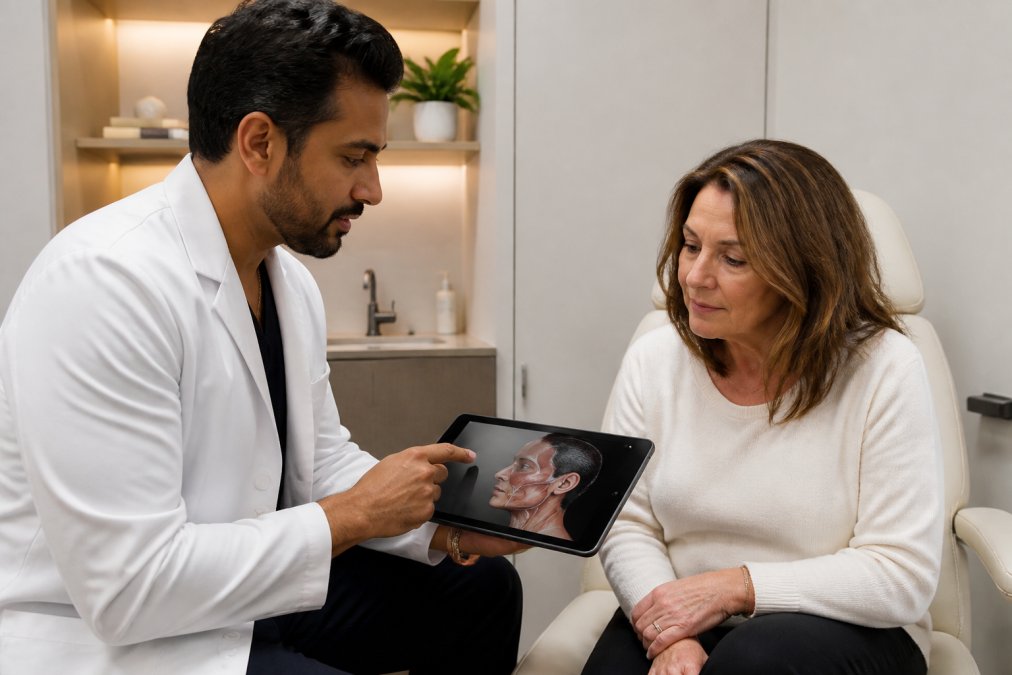
The consultation itself has three parts: clinical assessment, a conversation about your goals, and a treatment plan you agree to together. A thorough visit allows for a comprehensive discussion; a rushed one that skips steps is a warning sign, not a convenience.
Step 1: The Clinical Assessment
A thorough practitioner assessment starts with your face at rest, then in motion. Your provider watches how your brow moves when you raise it, how your cheeks sit when you smile, and where volume has been lost versus where skin has laxity. Those are different problems with different solutions, volume loss calls for fillers or biostimulators, laxity calls for energy-based tightening or threads, and dynamic lines call for neurotoxins.
Expect your provider to examine you in natural light, palpate areas of prior treatment, and ask you to make specific expressions.
Step 2: The Goal-Setting Conversation
Active listening runs both directions. Your provider should ask what bothers you, not just tell you what they see. If you say "I don't want to look frozen," that is a clinical instruction, not a preference, and it should shape the plan.
Step 3: Psychological Screening and Body Dysmorphia Awareness
This is the step most patients never hear about, and it is one of the clearest markers of a responsible practice. Body dysmorphic disorder (BDD) is a recognized psychiatric condition in which a person becomes preoccupied with a perceived flaw that others either cannot see or consider minor.
Step 4: Building the Plan Together
By the end of the visit, you should have a clear understanding of the recommended treatment plan, including products, sequencing, and estimated costs. You should also know what the provider recommends against, and why. A plan with no 'no' in it is a menu, not a medical recommendation.
Questions to Ask Before Botox and Other Injectables
Questions to ask before Botox and other injectables should cover who performs the treatment, what product is used, and what happens if you do not like the result.
Ask these directly:
- Who will perform the injection, and what are their credentials?
- Which product are you recommending, and why that one over the alternatives?
- How many units or how much volume do you expect to use?
- What are the procedural risks specific to my anatomy?
- What does follow-up care look like if I have a concern?
Cosmetic Procedure Recovery Expectations and Follow-Up Care
Cosmetic procedure recovery expectations vary widely by treatment. Neurotoxins typically show effect over several days and involve minimal downtime. Fillers can produce swelling and bruising that resolves over roughly a week. Thread lifts and laser treatments carry longer timelines.
Typical Timelines and What Affects Them
Several factors shift your recovery window:
- Treatment intensity and area treated
- Your medication list, particularly blood thinners
- Individual healing response and skin type
- Whether you follow pre- and post-procedure care instructions
Pre-procedure preparation matters as much as aftercare. Avoiding alcohol and blood-thinning supplements for several days beforehand reduces bruising. Skipping that step is why some patients bruise heavily and blame the injector.
MedlinePlus overview of cosmetic procedures and recovery
Red Flags and Financial Transparency: Protecting Yourself
Red flags in a provider fall into two categories: clinical shortcuts and financial pressure. Both are worth watching for before you commit.
Clinical Red Flags
- Injections performed by someone other than the evaluating clinician, with no explanation of who they are or their credentials
- No medical history taken, or a history form you fill out that nobody reviews with you
- Pressure to decide today, often framed as a limited-time offer or a same-day discount
- No discussion of risks, only benefits
- No clear answer about who to call if something goes wrong, or what the after-hours process is
- A provider who will not tell you no, or who agrees to every request without discussing trade-offs
- Unsterile or unclear product sourcing, ask to see the vial, and confirm it is FDA-approved for the intended use
- A single injector handling multiple patients at once, with no dedicated time for your assessment
Financial Transparency: The Questions Most Patients Forget
Cost is where consultations most often go sideways, because the quoted price is rarely the all-in price. Ask for a written estimate that separates each line item:
- Consultation fee, some practices waive it if you book treatment, some do not. Get it in writing either way.
- Per-unit or per-syringe pricing, neurotoxins are priced by unit, fillers by syringe, and the number used can vary from the estimate once the provider sees your face in motion.
- Follow-up and touch-up policy, is a two-week check-in included, or billed? Is a touch-up free, discounted, or full price?
- Revision or correction pricing, if you are unhappy at the two-week mark, what does it cost to adjust?
- Maintenance costs, neurotoxins typically need retreatment every three to four months, and fillers every six to eighteen months depending on the product and area. Multiply the per-treatment price by the annual frequency to get your real yearly cost before you commit.
- Financing options, many practices offer third-party payment plans. Ask what the terms are, whether there is interest, and whether the financing company runs a credit check.
Conclusion
The consultation is where a cosmetic outcome is actually decided, long before any needle comes out. Patients who prepare their medical history, ask direct questions, and insist on financial clarity get better results and fewer regrets.
Frequently Asked Questions
What should I expect during a medical aesthetics consultation?
A medical aesthetics consultation typically begins with a review of your medical history, medications, and aesthetic goals. The provider will assess your facial anatomy, skin quality, and discuss treatment options such as injectables, dermal fillers, or skin rejuvenation. You should expect a physical assessment, a personalized treatment plan, and a conversation about procedural risks, recovery time, and costs. You should leave with a clear understanding of next steps and informed consent requirements.
How do I prepare for my first cosmetic procedure consultation?
Before your first cosmetic procedure consultation, gather a list of your current medications, allergies, and prior aesthetic treatments. Note your medical conditions and any history of cold sores or keloids. Bring a list of questions about the provider's credentials, safety protocols, and the specific products they use. Avoid wearing heavy makeup if you expect a facial assessment. Being honest about your health and expectations helps your provider create a safe, personalized approach and reduces the risk of complications.
What questions should I ask before Botox or fillers?
Ask who will perform the injections and what their credentials are. Inquire about the specific product used, whether it is FDA-approved, and what results you can realistically expect. Ask about potential side effects, recovery time, and what to do if you are unhappy with the outcome. Also ask about the total cost, including any follow-up visits or touch-ups. A reputable provider will welcome these questions and provide clear, honest answers without pressure.
How long does recovery take after non-surgical treatments?
Recovery time varies by treatment. Neurotoxins like Botox typically have no downtime, though minor swelling or bruising can occur for a few days. Dermal fillers may cause swelling or bruising for up to a week. Laser treatments and chemical peels often involve redness or peeling that resolves within several days to two weeks. Your provider will give you specific post-procedure care instructions and a realistic timeline based on your treatment plan and individual healing factors.