 how-to
How to Book a Cosmetic Medical Consultation in Williamsport
Table of Contents
- Why a Physician-Led Cosmetic Consultation Matters
- Medical Aesthetics Consultation Checklist: What to Bring and Ask
- Step-by-Step: How to Book Your Appointment
- How Many Laser Hair Sessions Will You Need?
- Understanding Costs and Financing Options
- Safety and Certification Standards in Medical Aesthetics
- Conclusion: Your Next Step Toward Natural-Looking Results
- Frequently Asked Questions
Last Updated: September 10, 2026
Why a Physician-Led Cosmetic Consultation Matters
A cosmetic consultation with a physician is a medical evaluation, not a sales pitch, and that distinction shapes everything from which treatments you're offered to how safely they're performed. At Medical Aesthetics and Lasers in Williamsport, every aesthetic plan starts with a licensed physician reviewing your history and goals before anyone discusses injectables or lasers. That matters because cosmetic procedures are still medical procedures: they carry risks, interact with medications and health conditions, and produce better results when the person holding the needle or device understands your full clinical picture. A physician-led approach also means someone is accountable for outcomes, not just bookings. If you've ever walked into a spa and left with a package you didn't fully understand, you already know why that accountability is worth seeking out.
Medical Aesthetics Consultation Checklist: What to Bring and Ask
A good medical aesthetics consultation checklist turns a vague conversation into a productive one. Bring the right documents, ask the right questions, and you'll leave knowing exactly what's realistic for your face, body, or hair.

Documents and Information to Prepare
- A current list of medications, including blood thinners, retinoids, and supplements
- Your medical history: autoimmune conditions, cold sores, prior surgeries, allergies
- Previous cosmetic treatments and how your skin responded
- A photo of yourself from 5-10 years ago, useful for discussing natural-looking goals
- Your budget range and schedule, so the plan fits your life
- Questions you want answered, written down, so nothing gets forgotten in the room
Questions to Ask About Safety and Credentials
Ask who will actually perform the treatment, what their training and board certifications are, and what the plan is if a complication occurs. Ask about the specific products and devices being used, whether they're FDA-cleared for your intended use, and what the realistic downtime looks like. A physician-led practice should welcome these questions, not deflect them. If a provider can't tell you who's holding the syringe or which device is being used, that's your signal to keep looking.
Step-by-Step: How to Book Your Appointment
Booking a cosmetic consultation takes about five minutes if you know which route you prefer. Most practices, including Medical Aesthetics and Lasers, offer both online scheduling and a direct phone line, and both get you to the same place: a scheduled, no-pressure evaluation.
| Step | What You Do | Time Needed |
|---|---|---|
| 1 | Choose online scheduling or call the clinic | 2-5 minutes |
| 2 | Share basic contact and goal information | 3-5 minutes |
| 3 | Confirm your appointment date and time | 1-2 minutes |
| 4 | Receive confirmation and prep instructions | Same day |
| 5 | Complete intake paperwork before your visit | 10-15 minutes |
| 6 | Attend your consultation | 30-60 minutes |
Online Scheduling and Phone Options
Online booking works well if you already know roughly what you want and prefer to handle it outside business hours. A phone call is better if you have questions about which provider to see or want to describe a complex concern before committing to a time. Medical Aesthetics and Lasers accepts requests at medicalaestheticsandlasers.com or by phone at 570-323-3106, and the clinic sits at 427 Hepburn Street, Williamsport, PA 17701.
What Happens After You Request a Consultation
Once your request goes through, the clinic confirms your appointment and typically sends intake paperwork to complete beforehand. Filling that out in advance saves time in the room and gives the physician a head start on your medical history. You'll also get instructions on anything to avoid before your visit, such as pausing certain medications or skipping makeup on the treatment area if a laser or injectable is planned.
Pre-Consultation Preparation Checklist
Most practices just say "call us" and leave the rest to you. That's a missed opportunity, because arriving prepared changes the quality of the conversation. Use this checklist in the days before your appointment:
- Medication and supplement list. Write down everything, including over-the-counter drugs, vitamins, and herbal supplements. Blood thinners such as aspirin, warfarin, and clopidogrel, plus fish oil, ginkgo, and high-dose vitamin E, all affect bleeding and bruising risk. Some antibiotics and retinoids also interact with treatment plans.
- Medical history summary. Note autoimmune conditions, a history of cold sores or shingles, prior surgeries, bleeding disorders, and known allergies, especially lidocaine or numbing agents.
- Previous cosmetic treatments. List what you've had, when, who performed it, and how your skin responded. This is especially important if you've had fillers, because some products can last a year or more and affect what's safe to add.
- Goal photos. Bring one or two photos of yourself from 5-10 years ago, plus any reference images you've saved. A photo from your own past is more useful than a celebrity image because it reflects your actual bone structure and skin.
- A written question list. Jot down what you want to know about downtime, longevity, risks, and cost. It's easy to forget in the room.
- Schedule and budget notes. Know your realistic recovery window and a rough budget range so the plan fits your life rather than the other way around.
- Skin prep. Arrive with a clean face if a laser or injectable is planned. Skip makeup on the treatment area, and avoid sun exposure or self-tanners for several days beforehand, since tanned skin can complicate laser settings.
What to Expect in the Room
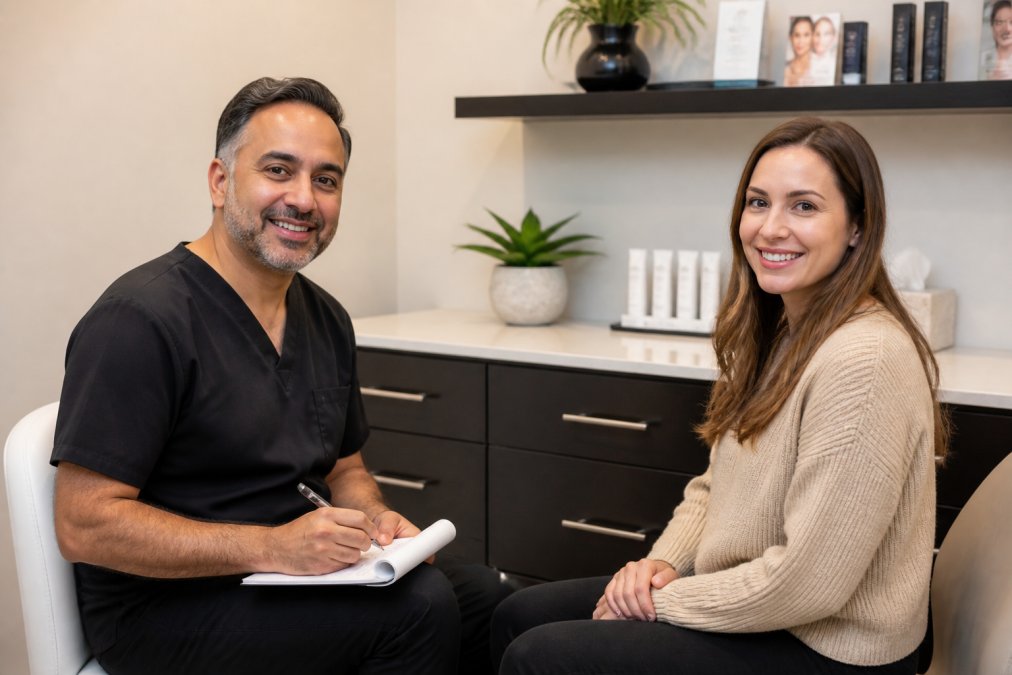
A physician-led consultation usually moves through four phases: a medical history review, a skin and facial assessment, a discussion of options with realistic expectations, and a written plan with costs. You should leave knowing which treatments are appropriate, which are not, what the total cost of a series looks like, and what the recovery window is. If you leave with a package you don't understand, that's a sign to slow down rather than sign.
How Many Laser Hair Sessions Will You Need?
Most people need a series of laser hair removal sessions rather than a single treatment, because hair grows in cycles and only actively growing follicles respond to the laser. A common range is six to eight sessions spaced roughly four to six weeks apart, though the exact number depends on hair color, skin tone, the treatment area, and hormonal factors. Coarse dark hair on light skin typically responds fastest; lighter or finer hair can take more sessions. Because hormones influence hair growth, conditions like PCOS or perimenopause can affect how many sessions you'll ultimately need.
Understanding Costs and Financing Options
Pricing for cosmetic and medical aesthetics treatments varies by provider, treatment area, and the number of sessions required, so no honest clinic quotes a flat figure before seeing you. What you can control is how you plan for it. Ask for a written treatment plan with itemized costs before you commit, and ask whether the practice offers payment plans or third-party financing. Many clinics, including Medical Aesthetics and Lasers, offer flexible treatment financing so a multi-session plan doesn't have to be paid all at once.
How Consultation Fees Typically Work
Consultation billing is one of the least transparent parts of the industry, so it's worth asking directly. A common pattern is one of three structures:
- Complimentary consultation. The visit is free, with the expectation that you'll book a treatment. This is common at medical spas competing for new patients.
- Flat consultation fee. A set fee, often in the range of what a specialist copay would cost, charged regardless of whether you book. This filters for serious inquiries.
- Fee applied to treatment. You pay for the consultation, and if you book a treatment within a set window, often 30 to 90 days, the fee is credited toward your treatment cost.
Ask which structure applies before you schedule, and ask whether the fee is refundable if the physician determines you're not a candidate for what you wanted. A practice that won't answer that question clearly is telling you something.
What Drives the Total Cost of a Treatment Plan
Four variables move the number most:
- Number of sessions. Laser hair removal, skin resurfacing, and body contouring almost always require a series. A single-session price is not the price of the result.
- Treatment area. A small area like the upper lip costs far less per session than a large area like the back or legs.
- Product volume. Injectable pricing is usually per syringe or per unit. More areas treated means more product.
- Provider credentials. A physician-led practice typically prices higher than a salon or a nurse-only med spa, and that premium reflects oversight, emergency protocols, and accountability.
Financing and Payment Options
Most medical aesthetic practices offer at least one of the following:
- In-house payment plans. The practice splits the total across several months, sometimes with a small service fee.
- Third-party medical financing. Companies that specialize in health and cosmetic lending offer monthly payment plans, often with promotional no-interest periods for qualified applicants. Approval is typically a soft credit check for pre-qualification.
- Credit cards and HSA/FSA. Some medically necessary aesthetic procedures, for example, certain treatments for a diagnosed skin condition, may qualify for HSA or FSA reimbursement with a letter of medical necessity. Purely cosmetic procedures generally do not.
- Package pricing. Buying a multi-session package upfront usually costs less per session than paying visit by visit, but only if you're confident you'll complete the series.
Questions to Ask Before You Commit
- Is the consultation fee applied to treatment if I book?
- What is the total cost of the full recommended series, not just the first visit?
- Are there separate charges for follow-up visits, numbing, or post-care products?
- What happens if I need to reschedule or cancel, is there a fee?
- Do you offer financing, and what does the approval process look like?
Safety and Certification Standards in Medical Aesthetics
Safety in medical aesthetics rests on three things: who performs the treatment, what products and devices they use, and how they handle complications. In the United States, injectables and many energy-based devices are regulated by the FDA's medical device and drug approval information, and legitimate providers use FDA-cleared products for their labeled purposes. Physician oversight matters because complications like vascular occlusion from fillers, burns from lasers, or allergic reactions require medical judgment to manage. Board certification and hands-on training in aesthetic medicine separate a qualified provider from someone who took a weekend course. When you tour a clinic, look for visible credentials, ask about emergency protocols, and pay attention to whether the staff can explain what they're doing and why.
Conclusion: Your Next Step Toward Natural-Looking Results
The difference between a good aesthetic outcome and a disappointing one usually comes down to the consultation. A physician-led evaluation catches the health factors, medication interactions, and unrealistic expectations that a quick sales conversation misses. If you're ready to move from researching to doing, Medical Aesthetics and Lasers offers physician-administered injectables, laser treatments, and personalized care plans built around your goals, with flexible treatment financing and a compassionate, no-pressure setting. Book your cosmetic consultation at medicalaestheticsandlasers.com or call 570-323-3106 to get started.
Frequently Asked Questions
What should I ask during a cosmetic medical consultation?
Ask about the provider's credentials, how many procedures they perform, and what results are realistic for your goals. Request a personalized treatment plan and discuss potential risks and downtime.
How do I prepare for a medical aesthetics consultation?
Use a medical aesthetics consultation checklist: gather your medical history, list current medications and allergies, and note past cosmetic treatments. Bring a list of your aesthetic goals and questions. Arrive with a clean face if you expect skin analysis. This preparation helps your provider create a personalized care plan.
Are cosmetic consultations in Pennsylvania usually free?
Consultation fees vary by practice and provider. Some offices charge a fee that may be applied toward treatment, while others offer complimentary consultations. Medical Aesthetics and Lasers determines fees on a case-by-case basis; call 570-323-3106 or visit medicalaestheticsandlasers.com to ask about current consultation policies.
How many laser hair sessions will I need?
Most people need a series of laser hair removal sessions, typically spaced several weeks apart, because hair grows in cycles and treatment is most effective during the active growth phase. The exact number depends on your hair color, skin tone, treatment area, and hormonal factors. A provider will assess your situation and recommend a plan after a consultation.